
What actually happens
What you actually receive
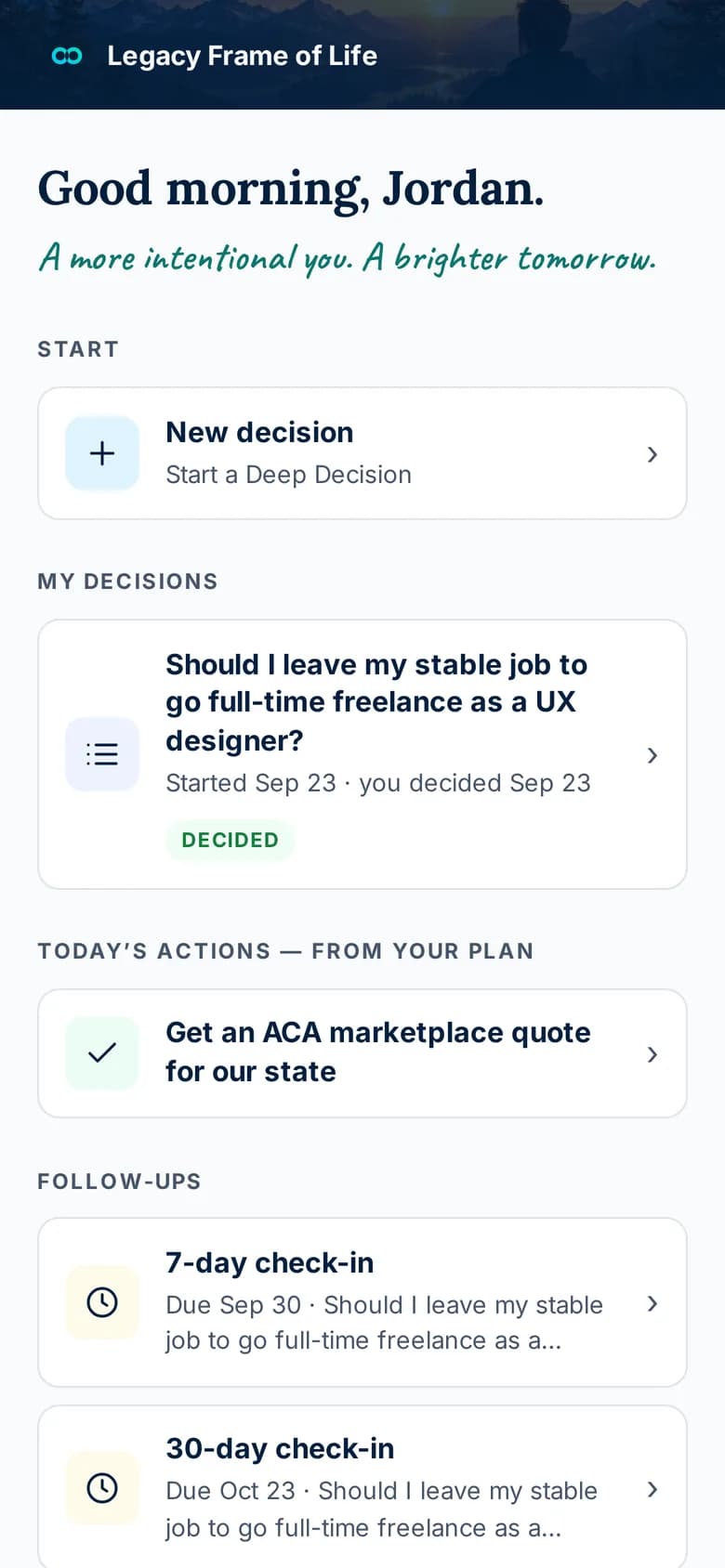
The real product, captured from one Deep Decision — not a mock-up.
SYNTHETIC EXAMPLE · NO REAL CUSTOMER DATA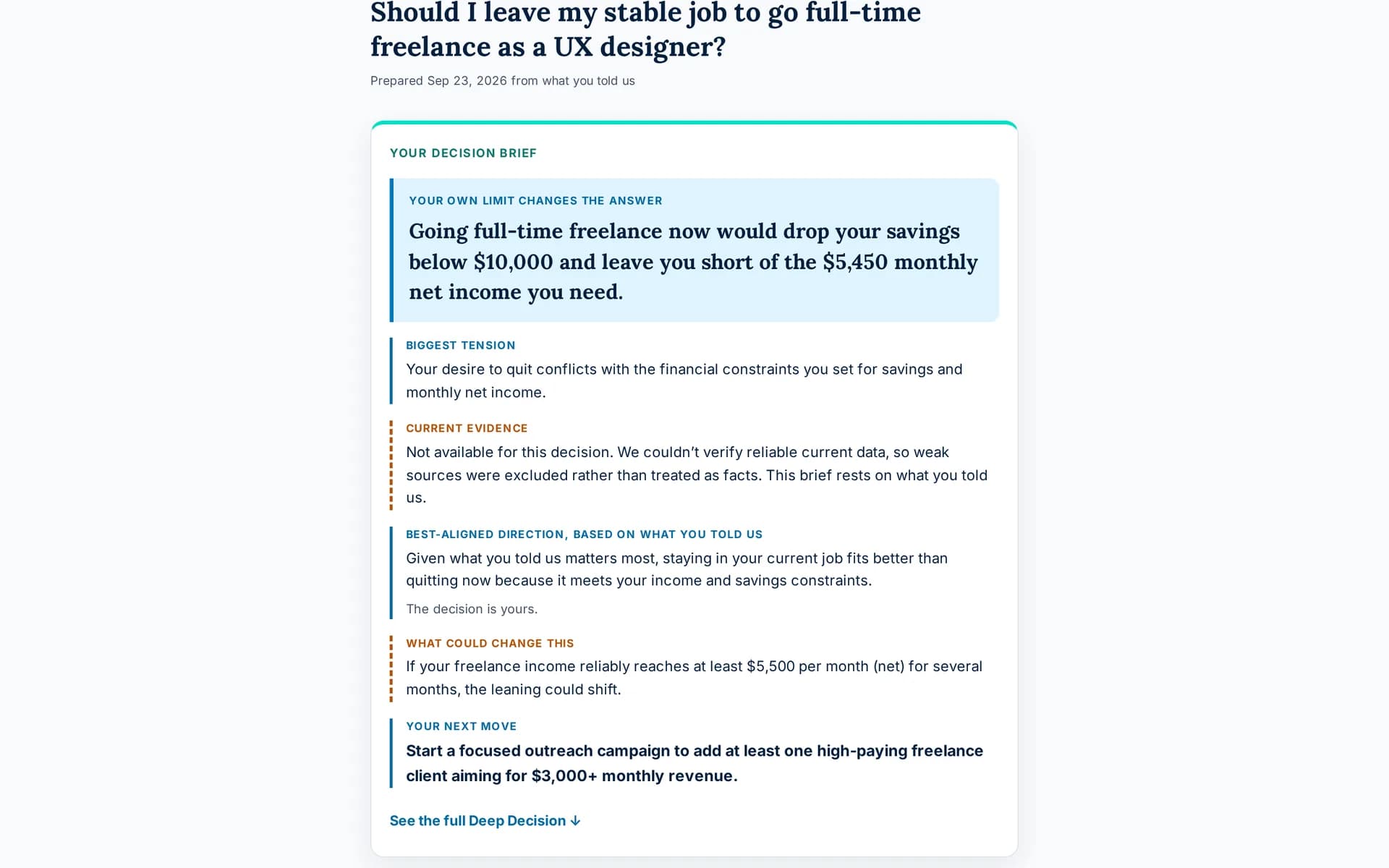
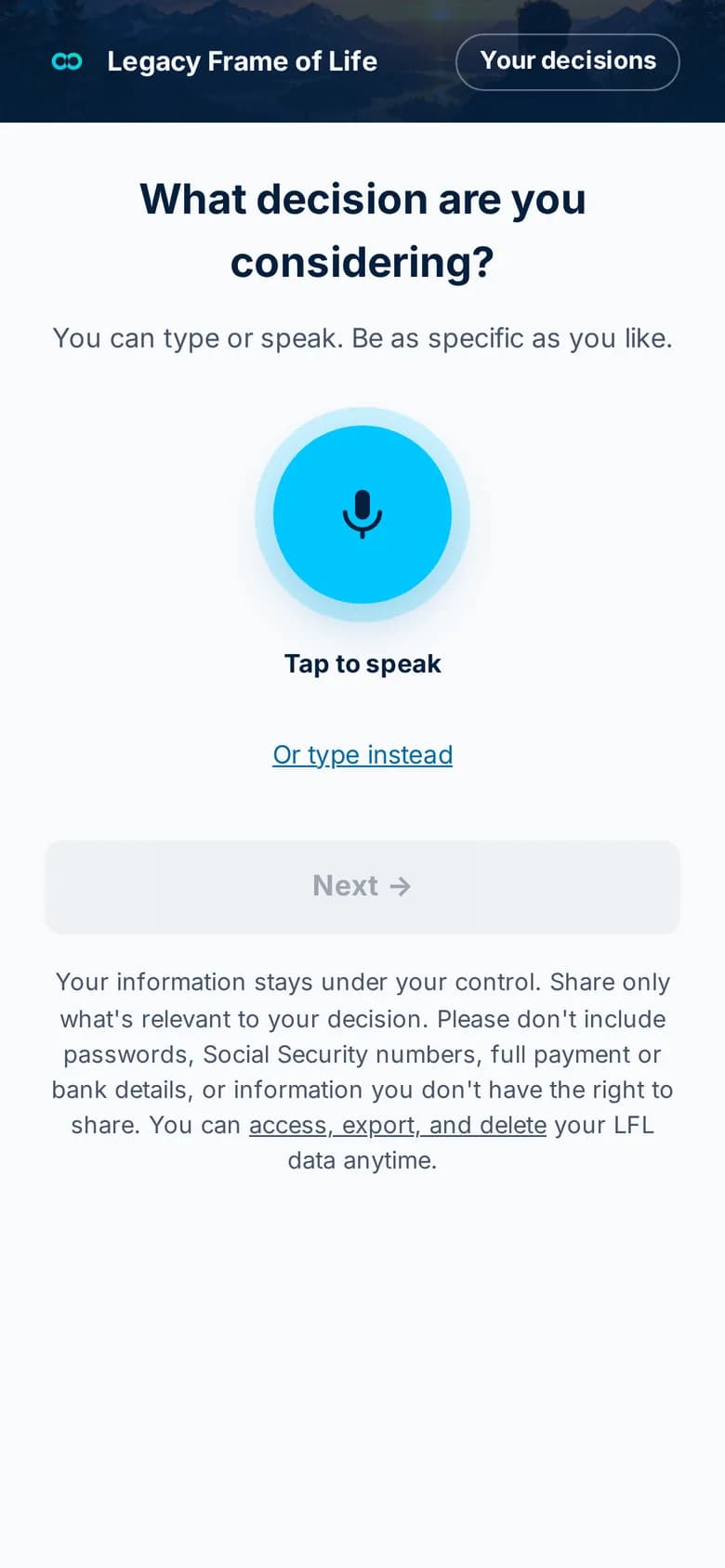
- 1Tell LFL what’s at stakeSpeak or type your decision. Follow-up questions bring out your limits and priorities.
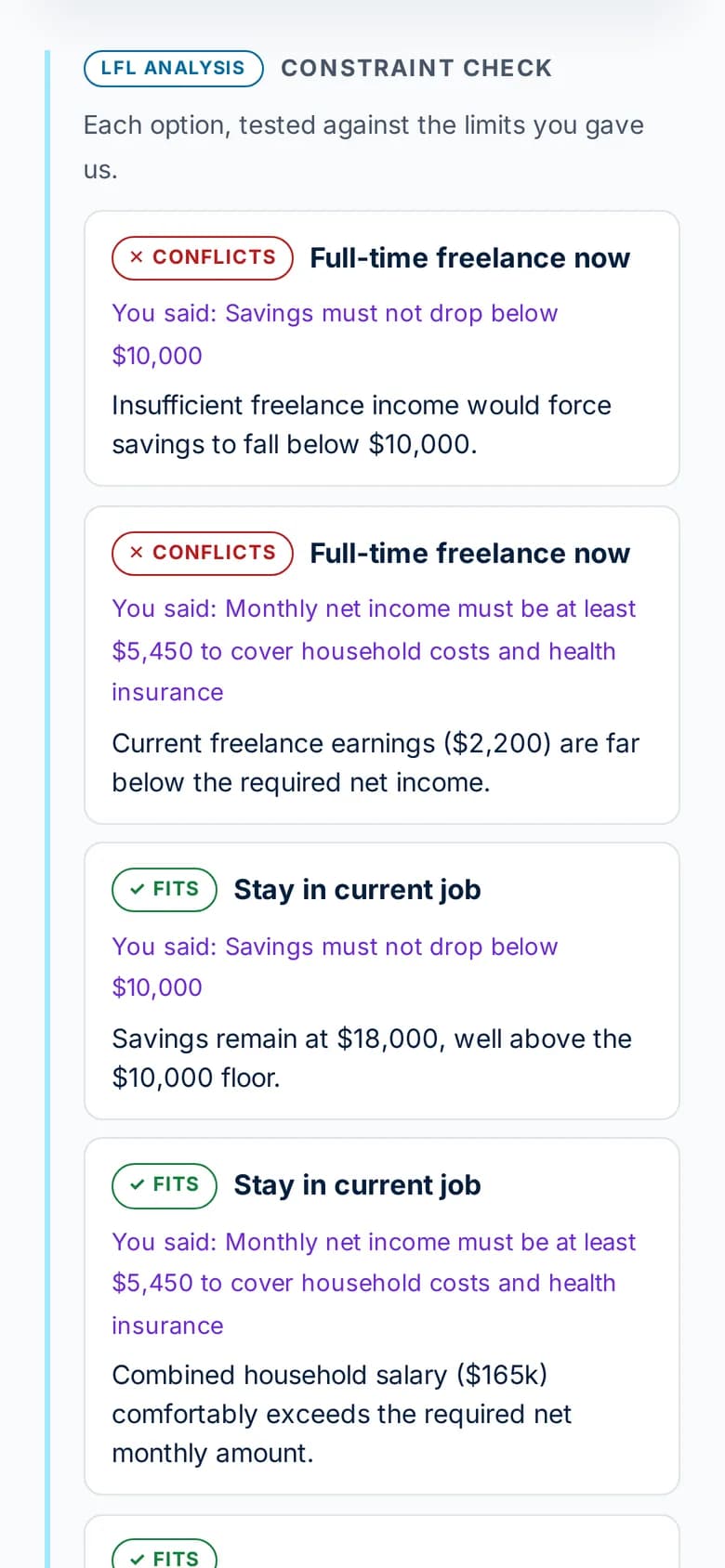
- 2See what changes the decisionCompare the options against your limits and inspect the conflicts the report identifies.
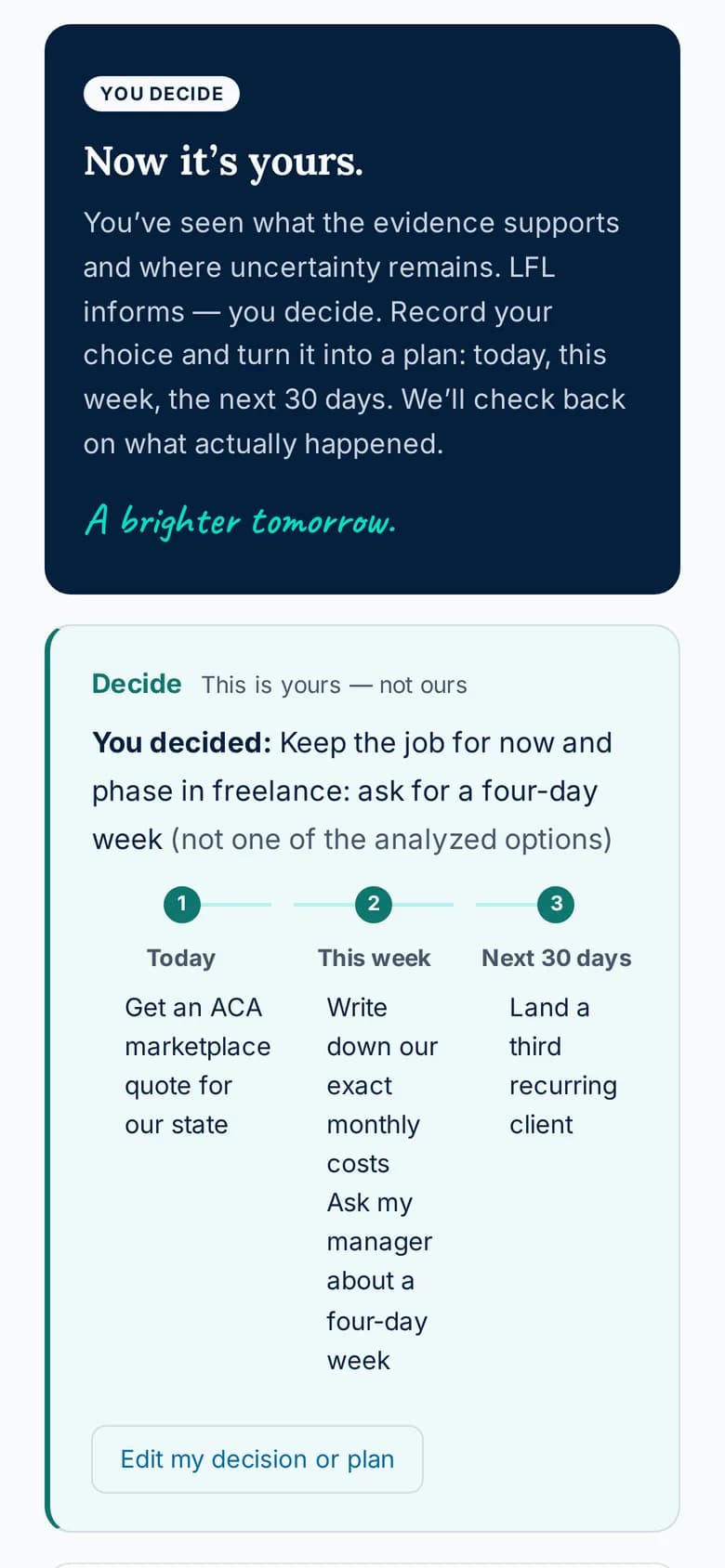
- 3You decideLFL informs. You make the call and record it in your own words.
- 4Turn it into actionYour plan, today’s actions and your 7- and 30-day check-ins in one place.
What are you weighing?
Start with the question in front of you, the limits you need to protect, and the facts you still need.


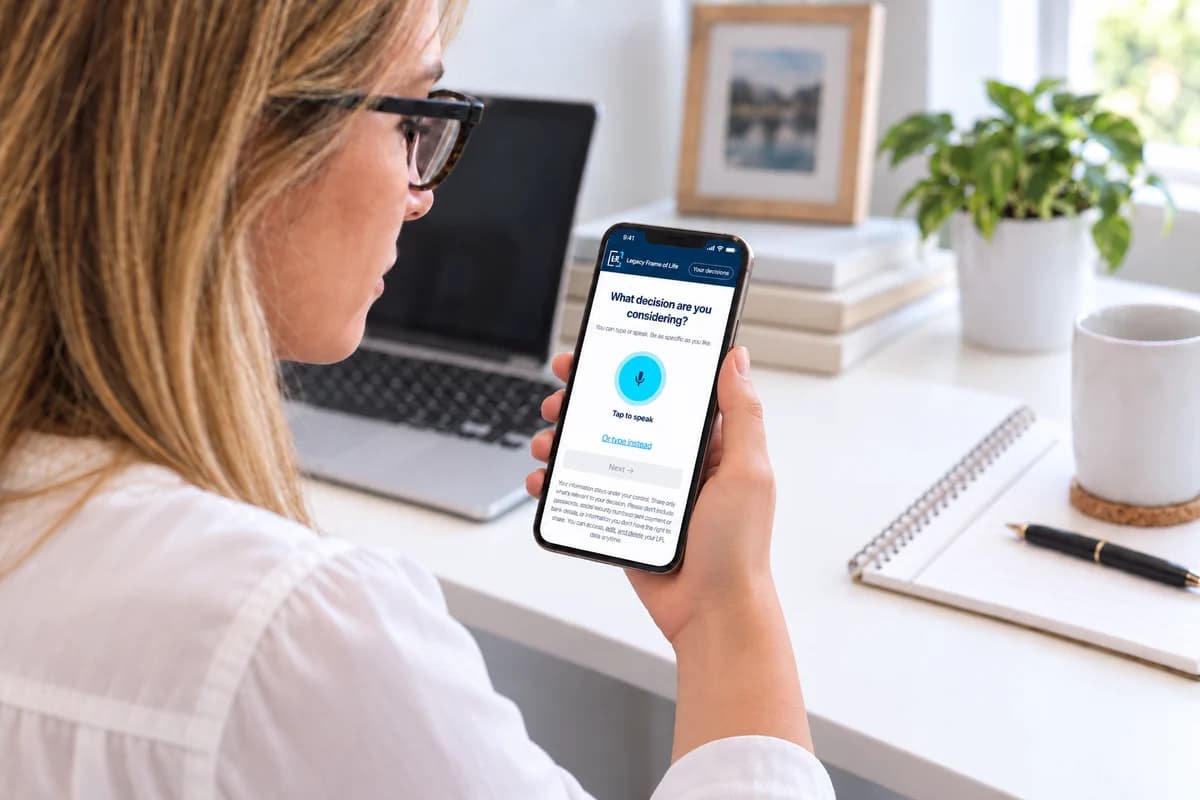
AI-assisted illustrations with example product screens. Not customer testimonials.

My goal is to help you look at a real decision with a clearer view of the facts, your limits, and what is still unknown. Then you make the call and decide what to do next.
See what the decision rests on.
Two possible plans. The tradeoff that matters. A next step with clear conditions.

Build your own work.
Protect what matters.
More independence. A financial boundary that stays yours.
- THE VISION
Make room for your own work.
Leave the job now, or test freelance work first?
- WHAT MATTERS
Independence, with a boundary.
$10,000 reserveClient commitmentCoverage timing - THE NEXT MOVE TO ASSESS
Start with one paid project?
Check client terms, employer permission, and available hours before committing.
A direction you can examine. A choice that stays yours.
Illustrative photograph and fictional scenario. Not a customer story or a live AI result.
Explore the plans, reasoning, and evidence
“Leave my job now — or test freelance work first?”
They want more independence, have $18,000 saved, and will not touch their last $10,000. A potential client is interested, but nothing is signed. Their health coverage comes through work.
Leave now
Make freelance work the main focus.
The tradeoffClient income is uncommitted. Household costs and replacement coverage still need pricing.
Test one paid project first
Explore demand before leaving the job.
The tradeoffLess immediate independence. Employer permission, project scope, and available hours are still unconfirmed.
Check whether a paid pilot is feasible before setting an exit date.
For these fictional facts, client interest alone does not establish a workable transition. A pilot is worth considering only if the employer permits it and the agreed scope fits confirmed available time.
Ask the client for a written scope, payment terms, and start date. Confirm employer permission and available hours before accepting.
What could change that direction? A signed commitment, a household budget, and confirmed replacement coverage could change the case for leaving. If a pilot cannot fit the job, Plan B is not established either.
Inspect the reasoning and original source
- The person’s priorities
- More independence without crossing the savings floor. Both plans, the interested client, and the job-based coverage are fictional scenario inputs, not facts inferred about a visitor.
- The financial boundary
- $18,000 − $10,000 = $8,000 above the floor. Without costs and reliable receipts, that cannot establish an affordable resignation date.
- A timing detail worth checking
- HealthCare.gov says losing job-based coverage after quitting can qualify you for a Marketplace enrollment period, and says to apply within 60 days of losing that coverage. This does not establish a personal premium or coverage start date.Read the original coverage guidance ↗Source reviewed September 23, 2026 · U.S. example
- How that affects the plan
- Confirm when the employer’s coverage ends and when replacement coverage could begin. Those dates belong in the transition plan alongside client payment dates and household costs. This is an interpretation of the scenario, not a conclusion supplied by HealthCare.gov.
Fictional worked example, written for illustration. Not a live AI report, customer outcome, or proof of product reliability.
Your data. Your control.
A real decision isn’t advertising inventory. Your decision content isn’t sold or used to target you. You make the actual choice — LFL never decides for you. You can export what LFL holds about you, or request deletion, at any time.
Manage your data →One Deep Decision — $39
Want to explore first? Try the free strengths assessment
Questions
What kinds of decisions is this for?
Real, personal decisions with actual constraints and tradeoffs — career moves, relocations, major purchases, business timing calls. Not medical, legal, tax, or other regulated advice; the product declines those and points you to a qualified professional instead.
What does the $39 include?
One Deep Decision: questions about your situation, a saved decision brief, a comparison of your options and limits, sources when available, and an action plan. You also get a place to record your choice and return for 7-day and 30-day check-ins. It is a one-time purchase, with no subscription.
Why use this if I already use ChatGPT or another AI?
Other AI tools can research and reason too. Deep Decision gives you a guided process for one decision, with your answers, report, recorded choice, and follow-up kept together. The value is that complete workflow. Look at the example to judge whether it adds something useful to the way you already work.
How long does it take?
Most of the time is yours — answering a few voice or typed questions about your situation. Report time varies with the questions and research needed.
Is this AI, and can it get things wrong?
Yes. Deep Decision uses AI, and it can make mistakes or miss something important. The report helps you compare options; it does not guarantee a correct answer or a better outcome. Check important facts before acting. If the analysis cannot be completed, your saved decision remains available to retry.
Where does the evidence come from?
The report separates your stated facts, external sources, and the model’s interpretation. When usable current sources are unavailable, the report identifies that gap. A citation is not a guarantee of accuracy; verify important claims against the original source before acting.
Does LFL decide for me?
No. The report lays out the options, the evidence, and the tradeoffs. Recording what you actually choose is a separate, explicit step — LFL can’t skip past it or fill it in on your behalf.
What happens to my data?
Your decision and answers are stored with your account and sent to an AI provider to prepare the report. We do not sell your decision content or use it to target you with ads. You can export or request deletion of your data from your account. The privacy policy explains provider processing and backup retention.
What if it isn’t useful to me?
Deep Decision comes with a 7-day satisfaction guarantee: if it isn’t useful to you, email us within 7 calendar days after your report is delivered and we’ll refund your purchase in full. If a technical problem on our side keeps it from being delivered, we’ll complete it or refund you, whenever you contact us. Full terms are on the refund policy page.
What if I need another decision?
You can start a new Deep Decision any time — each one is its own $39 purchase and its own report. LFL keeps track of your prior decisions on your account.
See the work before you decide.
Look through the example. See how the limits, tradeoffs, and next steps are laid out. Then decide whether that would help with the decision in front of you.
Inspect the example reportThe example uses a fictional situation. It is not a customer testimonial.